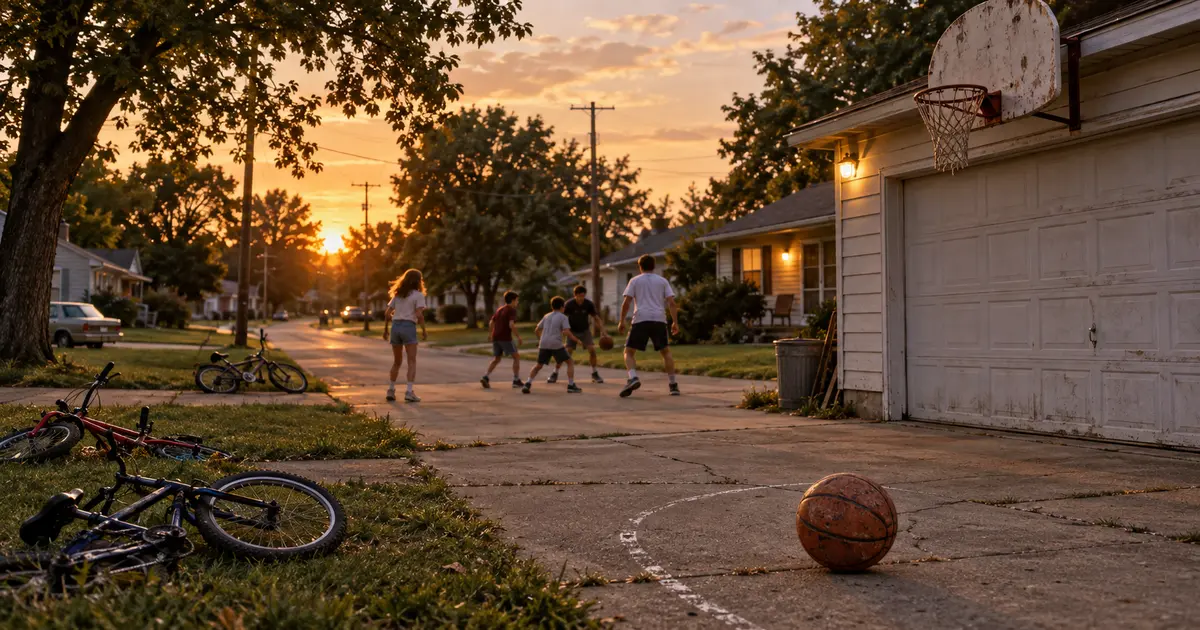
Every neighborhood had a basketball goal.
Only one had the good hoop.
The good hoop was not new. The backboard had gone gray around the edges, the rim leaned slightly toward the garage, and the net had been replaced often enough that nobody remembered its original color.
What made it good was not the equipment.
It was where the driveway met the street.
There was room for two bicycles near the mailbox, four in the grass, and several more thrown wherever their riders stopped caring about kickstands. The concrete was wide enough for a game and cracked enough to create local rules about which bounces counted.
Most afternoons, the first kid arrived alone.
He would shoot until the sound carried down the block: ball on concrete, ball against backboard, ball through net.
That sound worked better than a telephone.
A bicycle appeared from one direction, then another. Somebody came walking with a ball tucked under one arm even though a ball was already there. A younger kid stood near the curb pretending not to wait for an invitation.
Nobody sent a message asking who was available.
The bicycles in the grass were the message.
Teams formed badly. The tallest two kids could not be on the same side. Brothers argued that they had played together yesterday and should therefore be separated today. Whoever owned the driveway believed ownership came with first choice, though this rule was enforced only when his mother was within hearing distance.
Games went to eleven unless dinner interrupted at nine, rain arrived at seven, or somebody claimed the next basket was worth three because a car needed through.
The driveway had boundaries everybody understood and nobody could explain. A shot from the grass counted. A shot taken after stepping into the flower bed did not, mostly because the homeowner would appear at the window.
The garage door was out of bounds. The street was not, unless a car was coming.
When a car did come, the game stopped as one organism. Children moved, bicycles were dragged by handlebars, and the driver passed through a temporary tunnel of impatient faces.
Then the ball bounced again.
Older kids played harder when other older kids arrived. They lowered their shoulders and argued about fouls. But when a smaller child wandered onto the court, the game changed without anyone announcing it.
A pass found the smaller hands.
The defense became generous without becoming obvious.
The child shot from too far away, missed everything, chased the ball, and tried again.
When one finally went in, the celebration was loud enough to seem accidental.
Nobody called this inclusion.
Nobody had attended training on how to create belonging in unstructured recreational spaces.
The kids simply understood that a game lasted longer when there was room for one more player.
As evening came, porch lights replaced the sun one house at a time. Mothers called first names from screen doors. A father drove past slowly and pointed at his wrist even though he was not wearing a watch.
One bicycle left, then two.
The teams were adjusted again. Nine became seven. Seven became four. Eventually two children remained, taking shots in the dark and promising each other that the next make would be the last.
The final shot was never really final.
There was always a rebound, one more try, and a reason the rule did not apply yet.
Then the ball was tucked beneath an arm. The bicycles came up from the grass. Tires moved quietly toward different houses.
The driveway became ordinary again.
Years later, people remember the games as though they were scheduled events. They were not. No adult organized them. No one registered. There were no uniforms, standings, fees, or photographs taken for proof that childhood had occurred.
There was a hoop, a ball, and a street small enough for the sound to travel.
That was all it took to know where everyone was.


