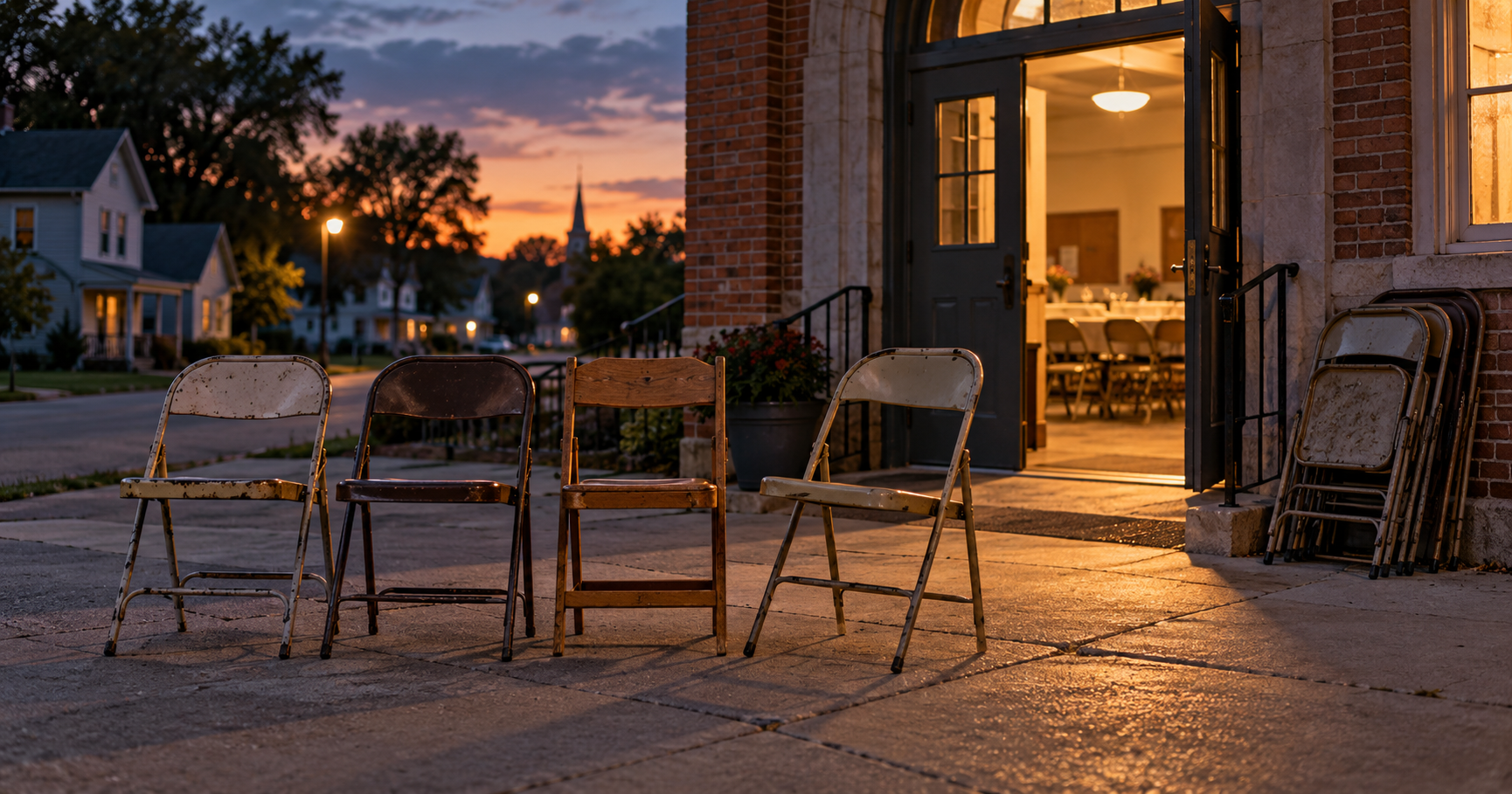
The hall owned thirty-two folding chairs. There were forty-seven people coming to supper.
Nobody knew this until the first thirty-two people sat down.
The chairs did not match. Some were brown metal, some were gray, and three had padded seats that made their owners easy to identify. One chair leaned so far left that it was given to a man who insisted he preferred sitting that way.
A woman at the door counted the people still standing. Then she counted the chairs again, as though one of them might have reproduced while she was looking away.
A boy was sent to the back room. He returned with a card table, a Christmas-tree stand, and no chairs.
The woman picked up her keys. Before she reached the door, two people said, ‘I’ve got some.’
That is how chairs used to arrive in a small town. Nobody placed an order. Nobody formed a committee to study seating capacity. Somebody opened a garage.
Four came out of a trunk with leaves stuck to their feet. Another six were carried from behind the counter at a nearby shop. A neighbor walked over with two wooden ones, one in each hand, and refused help because she had already walked this far.
Every new chair produced another place to put it.
The rows were pushed closer. A table moved toward the wall. People shifted coats from empty seats to the backs of occupied ones. The little gap near the door became enough room for three people who had arrived together and wanted to stay that way.
The late arrivals apologized for making trouble. They were told they had made no trouble at all. Someone handed each of them a plate before they could argue.
A folding chair is a practical object. It is also a small declaration: we did not know exactly who would come, but we can make room now that you are here.
The evening continued. Plates were passed. A child moved from lap to chair to floor and back again. Somebody's chair snapped shut the moment he stood up, and the sound made half the room turn around. A woman knew the person who had brought the padded chairs because she recognized the blue tape underneath one seat.
Across the table, an older man began telling a younger one what used to stand on the empty lot down the street. He pointed through the window. The younger man had passed that lot a hundred times and had never known there was anything to ask about it.
The story took longer than supper.
When people finally rose, the hall looked bigger than it had at the start. Chairs were stacked against the wall in short, uncertain towers. Nobody could remember which six belonged to the shop or whether the wooden ones had arrived before the gray metal ones.
The blue tape helped. The leaves under four chair legs helped. The woman with the keys knew the rest, or knew whom to ask.
By the next afternoon, every borrowed chair had gone home. The hall was back to thirty-two.
Nothing about the room had changed. Its walls were the same distance apart. The door was no wider. It still could not hold forty-seven people if all it had were its own chairs.
It had never needed to.


