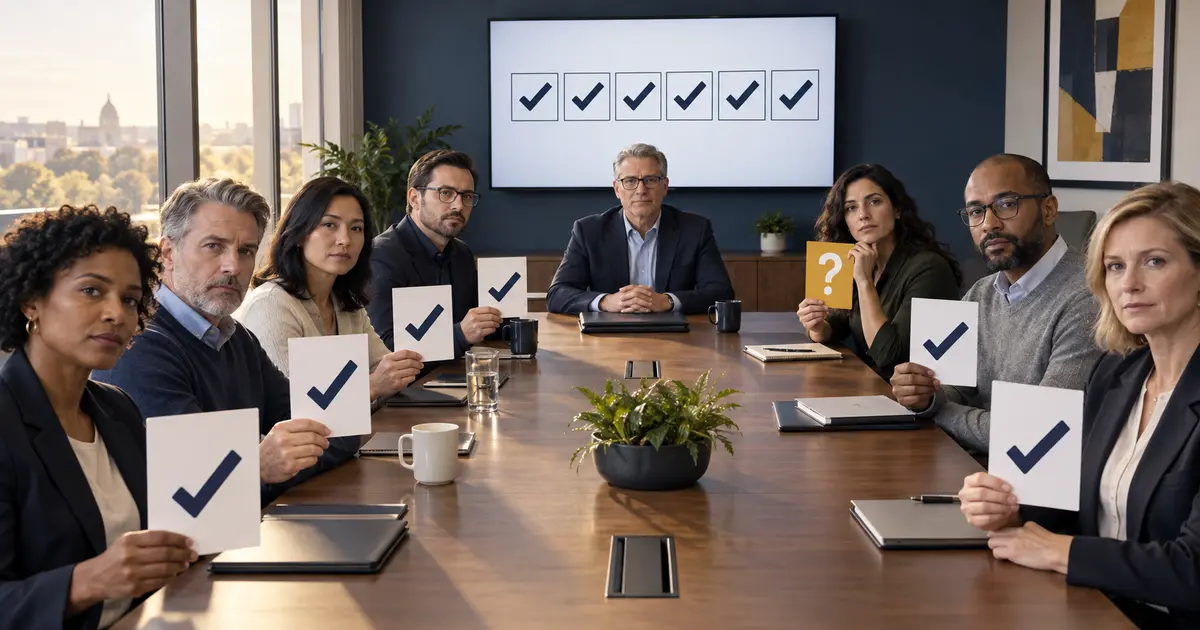
Imagine a school board asking whether a new program helped students.
The administration describes the rollout. Every school received the materials. Teachers attended training. Classrooms are using the tool. There are photographs, charts, and a timeline showing that the work happened.
That may all be true. It may also be useful. But the board asked whether the program helped students. The presentation answered whether the program reached classrooms.
The distance between those two questions is where a public conversation either begins or ends.
Someone has to ask: What changed for students? Compared with what? How do we know the program caused that change? What did it cost in money, time, and work that children might otherwise have done?
These are not hostile questions. They are the questions left after listening to the answer.
Advance notice is fair. A script is not the whole conversation.
I do not believe a superintendent should be ambushed with a complicated question and then judged for failing to produce a perfect answer on the spot. If records matter, give the person time to bring the records. If the issue has a history, let them explain it. If a decision involved tradeoffs, let those tradeoffs be heard.
Providing questions in advance makes an answer more likely to be informed. It also makes the process fairer to the person answering.
But advance notice creates a second responsibility for the interviewer. The interviewer has to know the question well enough to notice when the prepared response does not reach it.
A response can be polished, accurate, and incomplete at the same time. A district may have trained every teacher without knowing whether the training changed practice. It may have listened to parents without explaining what, if anything, changed as a result. It may have acted for defensible reasons while leaving the public unable to see those reasons.
The follow-up is not a trick added after the fact. It is the part that keeps the original question alive.
Listening creates the next question
A bad interview starts with a conclusion and searches for a mistake. A weak interview accepts every answer as a stopping point. Neither tells the public very much.
A serious interview requires more work. The person asking has to understand the issue before the conversation, listen during it, and be willing to change direction when the answer reveals something unexpected.
Sometimes the answer resolves the concern. That should be said plainly. Sometimes the answer shows that the concern was based on a mistaken assumption. That should be said, too.
Other times the answer introduces a new distinction. The district can show that an initiative was implemented, but not yet that it worked. The budget can show a purchase price, but not the staff time required to use it. A survey can show how many people responded, but not whether the decision was open to change when they did.
The next question follows from the answer, not from a desire to make the person answering look bad.
A board needs more than a report
School boards receive a great deal of information through the organizations they govern. That is necessary. Administrators do the work and know details that outsiders often do not.
It also creates a structural problem. The people preparing the report, selecting the slides, and framing the recommendation generally report through the same leadership structure the board is supposed to oversee.
That does not make them dishonest. It means the board should not mistake receiving information for having tested it.
An independent questioner can serve a different function. The role is to make sure the board's question is stated clearly, the superintendent receives a fair opportunity to answer, and the answer is followed when a material part remains unexplained.
The interviewer does not need to declare a winner. The public should be able to hear the question, the answer, the follow-up, and any honest uncertainty that remains.
Uncertainty is an answer
Not every question has a complete answer today. A superintendent might reasonably say that the results are too early to interpret, that two explanations remain possible, or that the district does not yet have the information it needs.
That is better than forcing certainty into a space where it does not belong.
But uncertainty should lead somewhere. What information would help? When will it be available? Who will examine it? What would cause the district to continue, revise, or stop the approach?
A candid 'we do not know yet' can build more trust than a confident statement about a different subject. It tells the board what decision is possible now and what decision must wait.
The point is the answer
I have no interest in a format built to embarrass superintendents. I have worked in schools long enough to know that decisions are rarely as simple as the loudest criticism suggests.
I also know that an organization can become very good at answering the question it wishes had been asked.
A fair public conversation makes room for both truths. The superintendent gets the question ahead of time and room for a full explanation. The board and community get an independent person who can hear that explanation and ask the next question when it is needed.
No ambush. No deceptive editing. No assumption that the first answer must be wrong.
And no rule that a prepared answer ends the conversation before the actual question has been addressed.
Ask the question. Listen to the answer. Then care enough about the answer to ask what comes next.