This morning, Mr. Yeser’s Underground reported that a state intends to move every student into the top 50 percent. The joke works because the language is only slightly more honest than many real improvement plans. We talk about eliminating the bottom, closing every gap, and moving all children above a line without first asking what the line measures or whether someone must always remain below it.
A percentile is a rank. It tells us how one result compares with the results in a reference group. If a child is at the 40th percentile, that does not mean the child answered 40 percent correctly, mastered 40 percent of the material, or has 40 percent of the capacity needed for a good life. It means the score ranked at or above roughly 40 percent of the comparison scores.
That distinction sounds technical. It becomes moral the moment a ranking is converted into a category of children who need to be fixed.
A ranking is not a standard
A standard can be met by everyone. Every child in a class can learn to write a clear paragraph, calculate with fractions, read a useful text, or demonstrate a defined skill. A percentile cannot work that way inside the population being ranked. It exists by placing results in order. There is a middle because some results are above it and some are below it.
An individual school or district can outperform a national comparison group. Students can improve their raw scores while their relative rank changes very little, and a student’s percentile can rise even when important abilities outside the test remain unchanged. Percentiles can answer a comparison question. They cannot carry every conclusion schools attach to them.
The mistake begins when the comparison becomes the goal. A child below the median is treated as if something has gone wrong, even when the child is learning, capable, and developing exactly the kinds of strengths the instrument does not measure.
The bottom half never disappears
When a system defines need primarily through relative rank, it creates a permanent supply of need. Improve the instruction. Raise the scores. Adopt a stronger curriculum. The ranking still produces a lower half. The names may change, but the category survives because the category is built into the measurement.
That does not make testing useless or every intervention unnecessary. It means the system must be honest about what the number can establish. A low percentile may be a reason to look more closely. It is not proof that a child has failed, that a teacher did not teach, or that the child’s schedule should now be organized around climbing the ranking.
Too often the first number becomes the whole story. A color appears on a dashboard. The child enters a group. The group receives a program. The program consumes time. Another assessment determines whether the child may leave. What began as one comparative signal becomes an identity with a schedule attached to it.
Comparison can hide real growth
Imagine two children who both become stronger readers during the year. One gains enough to move from the 35th percentile to the 45th. The other makes meaningful progress while the comparison group improves at a similar rate and remains near the 35th. The first result looks like success on the dashboard. The second can look like insufficient progress even though the child can do more than before.
The reverse is also possible. A rank can rise because the reference pattern changed while the child’s underlying growth remains modest. That is why a ranking should not be mistaken for a description. It locates a score. It does not explain the student sitting in the chair.
Teachers know this because they see the film while the assessment captures a frame. They know the student who reads slowly but understands everything, the student who tests well but avoids difficult work, the child who can repair anything placed in front of him, and the child whose confidence finally appeared in band, art, theater, agriculture, a shop, or a gym.
The label changes the life around the child
The cost is not limited to how adults talk. Once a child is placed in the bottom category, schools begin moving time around the label. An elective disappears for intervention. Independent reading becomes test practice. A project becomes a skill packet. The child spends more of the day rehearsing the narrow domain in which the system has already told him he is behind.
Some children need intensive support, and schools should provide it. But support should respond to a specific capability a child needs, not to the mere fact that a ranking contains a lower portion. The question is not whether the child is below someone else. The question is what the child cannot yet do that matters enough to require time, expertise, and a different approach.
Without that discipline, intervention becomes a permanent address. The system keeps treating the rank while the child loses access to the places where competence, belonging, and motivation were already visible.
Build a real floor, then let children grow above it
Every child deserves a floor: the essential reading, writing, mathematical, civic, and practical capabilities needed to participate in adult life. Below that floor, schools should respond with urgency, skill, and patience. The floor should be concrete enough that adults can say what the child needs and recognize when the need has been met.
Above the floor, children need room to become different from one another. Difference is not a defect. A healthy society requires people who build, repair, teach, care, calculate, organize, create, lead, grow, design, listen, and notice things other people miss. Those gifts will not appear in equal order on a single assessment, and they should not.
The purpose of education cannot be to arrange every child in the same direction and then call the lower half unfinished. The purpose should be to make sure every child has a strong beginning and enough genuine opportunity to discover where ability, responsibility, and interest meet.
Measure what the decision requires
Schools need information. Families deserve to know how their children are doing. Teachers need evidence that helps them adjust instruction. But every measure should have a defined job. What decision will this result change? What can this assessment reveal that the teacher cannot already see? What support begins because of it, and what evidence allows that support to end?
If the answer is simply that the score identifies the bottom half, the system has confused sorting with learning. Sorting guarantees a bottom. Learning asks whether a particular child is more capable today than yesterday and what experience should come next.
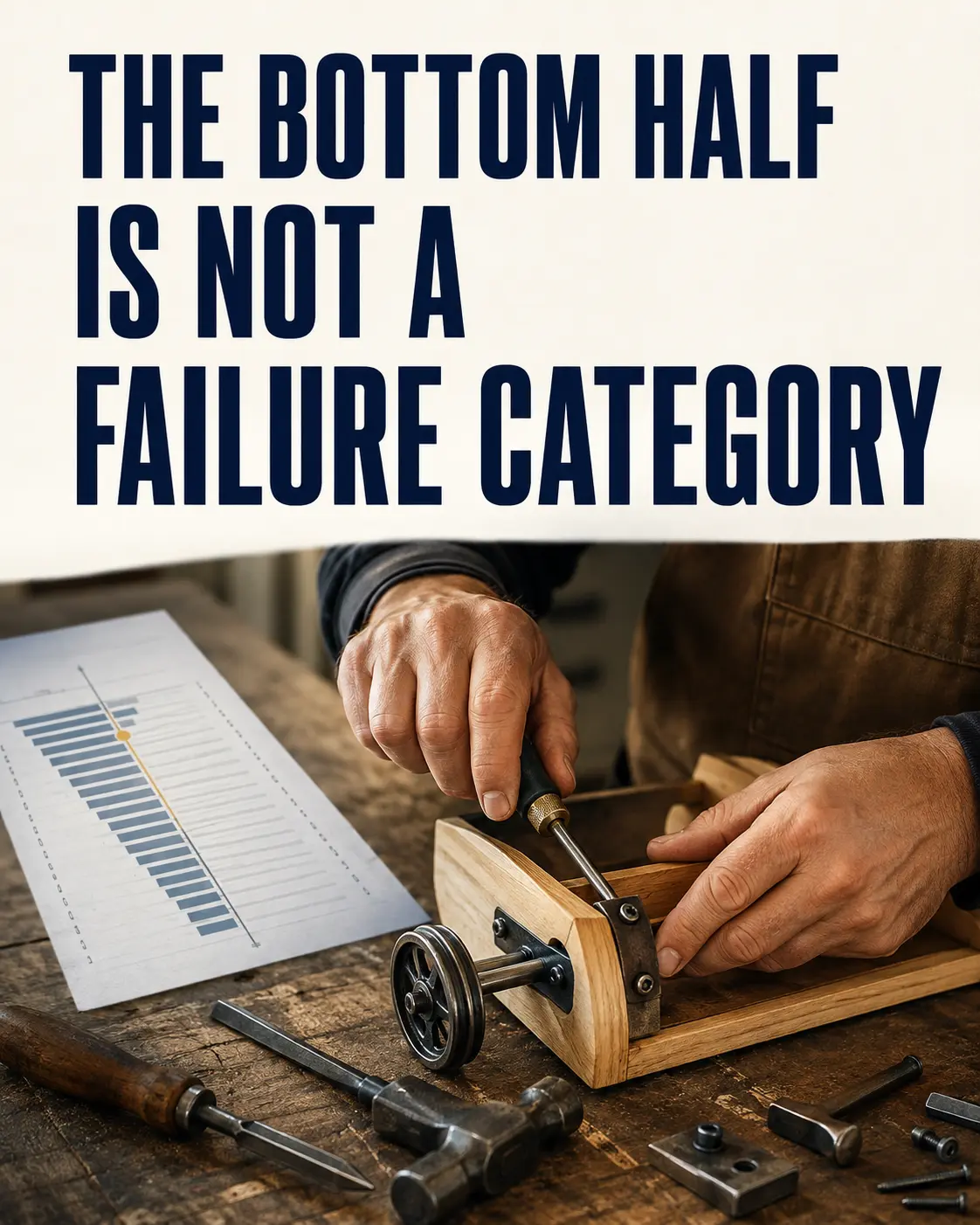
A percentile may help us notice. It should never be allowed to decide what a child is. The bottom half is a mathematical location. It is not a failure category, a life sentence, or a group of children whose other gifts can wait until the ranking finally releases them.