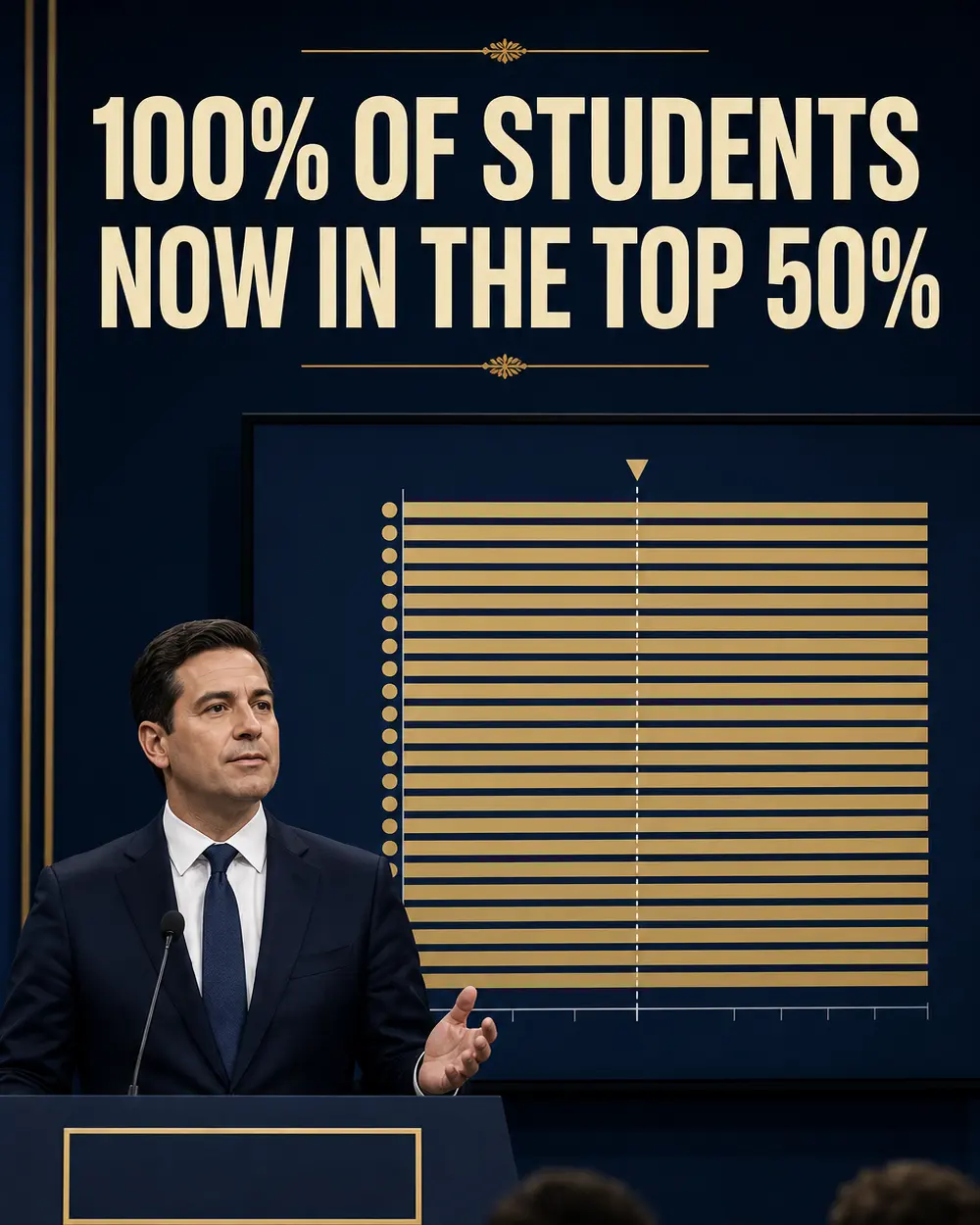
The State Office of Student Advancement announced Wednesday that every child will be moved into the top 50 percent of statewide performance rankings by the end of the academic year.
The Universal Above Average initiative establishes a clear equity goal: no student will remain below the middle once schools have received enough training, data meetings, intervention blocks, and updated dashboard colors.
Commissioner Elaine Porter called the plan ambitious but necessary. ‘For too long, we have accepted a system in which half of all students are permitted to rank in the bottom half,’ she said. ‘That is not the future our children deserve.’
Porter said the department will not allow traditional mathematical assumptions to become excuses for low expectations.
Mathematics enters corrective action
Department analysts briefly noted that a percentile is a relative rank and that the 50th percentile is defined by the existence of results above and below it. The concern was forwarded to the Office of Barrier Removal, where it was classified as fixed-mindset implementation language.
Officials clarified that mathematics remains an important state priority but must not be used in ways that limit student potential. A revised technical memo now describes the bottom half as an outdated distribution practice rather than a numerical requirement.
The state will provide professional development to any statistician who continues to suggest that 100 percent cannot fit inside 50 percent. The first session, Believing Beyond the Denominator, will be mandatory for data teams and strongly encouraged for fractions.
Districts receive individual elimination targets
Every district must submit a Bottom Half Elimination Plan identifying which students currently occupy the lower portion of the ranking, which interventions they will receive, and who will be responsible if the ranking still contains a lower portion in May.
Schools may use tutoring, test preparation, schedule changes, additional benchmark assessments, or temporary removal from electives. Leaders emphasized that no option should be dismissed merely because it reduces the time available for the activity being measured.
Teachers will meet weekly to review students approaching the 50th percentile. When a child crosses the line, the team will celebrate the movement before identifying the child whose new relative position has placed them below it.
‘The important thing is continuous progress,’ Porter said. ‘The bottom may keep moving, but our commitment to chasing it will remain stable.’
Families receive a clearer picture
Parents will receive a monthly Universal Achievement Report showing each child’s percentile, projected percentile, color band, intervention status, and distance from a target that changes whenever everyone else is measured again.
The report will not attempt to describe what the child can build, explain, repair, create, remember, question, or do for another person. Those abilities vary too widely to be displayed on a common scale and could distract from the precision of the ranking.
A parent who asked whether her son’s improved reading mattered even though his percentile remained the same was assured that growth is very important. She was then directed to the percentile because it was the number available.
The solution is ready to scale
Three education vendors have already introduced Universal Above Average support packages featuring predictive dashboards, intervention libraries, executive coaching, and a new assessment designed to identify students whose earlier assessments failed to improve their assessment position.
The state has not selected a vendor but confirmed that the initiative will require a sustainable multiyear partnership. Funding will be prioritized for districts with the largest bottom halves, creating a strong incentive to eliminate the condition while documenting its continued urgency.
Mr. Yeser praised the plan. ‘Absolutely,’ he said. ‘If half the children remain below the middle, that is not a feature of ranking. It is an implementation gap. Test them again, provide another intervention, and continue until the denominator understands the expectation.’
The department will declare the initiative successful when every district reports that all students are above average, every dashboard is green, and no one asks what average means.