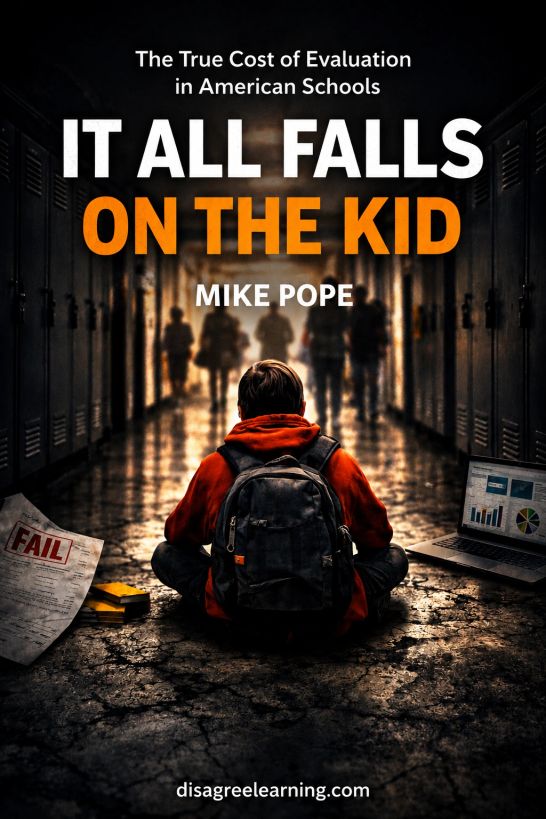
The biggest problems in schools aren't always the things that happen once.
Sometimes they're the things that happen every day.
This week, news coverage focused on allegations of racist and homophobic harassment at a high school football game involving New Trier and Evanston Township. Students reported serious mistreatment, and the districts said they were investigating. Those allegations deserve to be taken seriously. The investigation should establish what happened, and the students involved deserve a fair and appropriate response.
But watching the attention surrounding a single event, I keep returning to a different question.
What happens to the problems that never produce a headline?
Think about an ordinary classroom.
A student arrives late. Another has a phone out. Someone is repeatedly interrupting. Another student needs more support than the teacher can provide alone. The teacher redirects, restarts, answers a question, settles another interruption, and tries to get back to the lesson.
Nobody has committed an offense that will lead the evening news. There may be no one dramatic event to investigate.
Yet instruction has been interrupted.
And tomorrow, it may happen again.
If a class loses ten minutes of instruction each day, that's fifty minutes in a five-day week. Across thirty-six weeks, it's thirty hours. That's an illustration, not a claim that every classroom loses that amount. The actual impact depends on the students, teacher, classroom, and support available.
But the arithmetic reveals something worth examining: small, repeated disruptions can accumulate into a significant educational cost.
And the cost isn't borne by just one person.
The student who struggles to stay engaged may need help that hasn't arrived. The child who is repeatedly disruptive may be communicating a need that adults have not adequately understood. The teacher may be working within policies and staffing arrangements that leave few effective options. Other children may lose the continuity they need to learn.
Blaming one child doesn't solve those conditions. Blaming the teacher doesn't solve them either.
We are often very clear about what happens when there is a serious incident.
Schools have reporting procedures, investigations, discipline policies, administrative reviews, and sometimes law-enforcement involvement. There are good reasons for many of those safeguards. A serious allegation of harassment, violence, or threats cannot simply be dismissed because other problems also exist.
But an incident is something that happens.
A condition is something people have to work and learn within.
The distinction matters because responding to an incident and improving a condition are different responsibilities.
A principal may resolve a particular fight and still have classrooms where instruction is interrupted day after day. A superintendent may issue a public statement after a controversy and still be unable to explain how much classroom time is lost to repeated disruptions. A school board may devote an entire meeting to one urgent event while rarely hearing about the ordinary obstacles teachers face.
This isn't proof that administrators don't care. It raises a question about what our systems make visible, measurable, and urgent.
And parents face the same visibility problem.
They see the football game. They hear about the fight. They receive a notification when something serious happens.
But how often do they see the interruptions, the lost minutes, the repeated redirection, or the student who needs additional support during an otherwise ordinary Tuesday?
How often do they know which decisions a teacher can make independently, what help a principal can provide, or what requirements come from the district or state?
I've been asking school leaders questions about classroom decision-making, professional development, and the authority educators have to change what isn't working. Those questions aren't separate from classroom conditions. They're central to them.
Because identifying a problem is only the beginning.
Who has the authority to respond? What support is available? What evidence tells us whether the response worked? And what happens when the same problem continues?
That is where accountability should become more than a response to the latest controversy.
I also think we need to examine how news coverage shapes what the public notices. A serious allegation at a high-profile athletic event is a recognizable story, and it may deserve immediate coverage. But a repeated instructional problem is harder to photograph, harder to summarize, and less likely to arrive with one dramatic moment.
That doesn't make the second problem less important.
I started The Pope Report because I believe the public deserves sustained questions about what happens inside schools even when nothing extraordinary has occurred.
Not to accuse every school of failure.
Not to suggest every classroom faces the same challenges.
And not to turn children into villains.
I want to know what happens when good people inside a school recognize a problem that continues every day, and whether the system gives them the time, authority, resources, and permission to address it.
Here's a question I would like teachers, parents, and school leaders to consider:
What is one ordinary condition in your school that interferes with learning, but rarely receives the attention it deserves?
If we can answer that question, we can start asking the next one.
Who has the power to change it?
Schools need permission to change. And sometimes that means changing the conditions that everyone has learned to live with.
— Mike Pope The Pope Report | Pope Studios