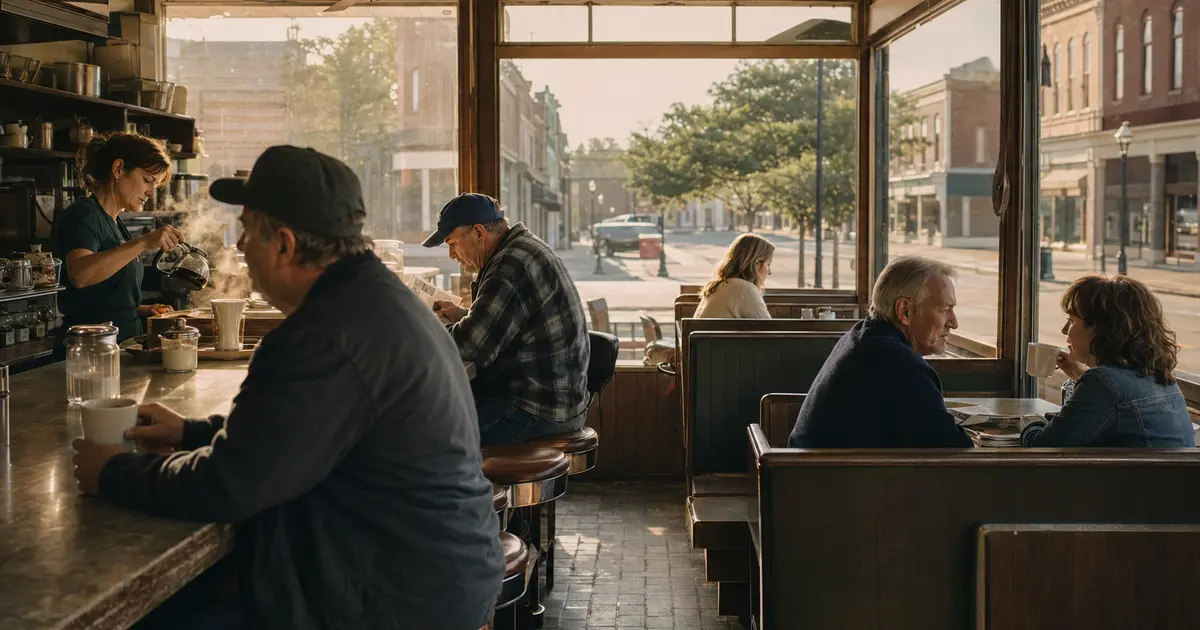
The first light on Main Street belongs to the café. It glows before the hardware store, before the bank clock has anything useful to say, and before the people driving through town have decided whether they are awake. From the sidewalk, the windows look gold. Inside, coffee moves from pot to cup with the steady purpose of something that has done this every Saturday for years.
No one announces the beginning of the day. The cook turns the griddle on. A chair scrapes. Somebody opens the sports section even though three people nearby already know the score. By seven, the room has formed its usual geography: farmers near the front window, two retired teachers in the corner, families in the long booth, and one man at the counter who insists he is only stopping in for coffee while eating half of somebody else’s toast.
The tables fill in their own order
The café does not need reservations because the town has already made them. People arrive by habit. A pickup pulls into the same space it used last Saturday. A woman carries in a church bulletin that will travel across three tables before breakfast is over. A coach sits down and immediately receives a question about a game that has not happened yet.
The waitress knows who wants cream, who says he does not want cream and will ask for it later, and who needs a full minute before speaking to another person. She calls everyone by name except the people she has known longest. They get called honey, trouble, professor, or whatever title they earned during a previous breakfast and have been unable to escape.
This is not efficiency in the ordinary sense. Orders pause for introductions. A plate may take the scenic route because its owner is standing at another table. A person who came in alone can spend twenty minutes trying to reach an empty stool while being intercepted by updates about a roof, a knee, a grandchild, and a lawn mower that has become a matter of principle.
News travels at breakfast speed
The café is not a newsroom. Nothing is confirmed, attributed, or placed on the record. Still, by eight o’clock, the room understands which road is closed, whose garage sale has the good tools, whether the rain was enough, and why the ambulance was near the water tower on Thursday. Facts arrive with coffee. Corrections arrive with refills.
A small town does not need everyone to know everything. It only needs enough people to know enough pieces. One person saw the truck. Another knows the family. A third has a cousin who works with somebody involved. The complete story may never appear, but concern does. A name is written down. A meal is planned. Someone says he will stop by after breakfast, and everyone understands that the sentence is a decision rather than conversation.
At the next table, children negotiate syrup with the intensity of diplomats. Their parents pretend not to hear the older men discussing school enrollment, property taxes, seed prices, and a foul call from a junior-high game six winters ago. The subjects share a table because the café does not separate public life from private life. It all comes through the same door wearing a coat.
Nobody stays only for breakfast
Around nine, the room changes. Ball caps give way to team jerseys. People heading to the grocery store stop in before the list gets longer. A family arrives late enough to call the meal brunch and early enough for the regulars to distrust the word. The first crowd begins leaving, but departures take time. Checks are paid. Conversations restart near the register. Someone remembers one more thing in the parking lot.
The café does not preserve the town in amber. Phones sit beside coffee cups. Scores appear on screens before they reach the sports page. People talk about new houses, new jobs, and children who live three states away. The room changes because the town changes. What remains is the useful closeness of it: the chance that a person can walk in for eggs and walk out carrying news, a small assignment, and the reminder that other people noticed he was there.
By late morning, the front window has lost its gold. Main Street is fully awake. The hardware store is open. Cars move in both directions. The waitress wipes the long table and resets the sugar packets. Tomorrow will have its own crowd, but Saturday has already done its work. The town has eaten. The town has checked on itself. The rest of the weekend can begin.