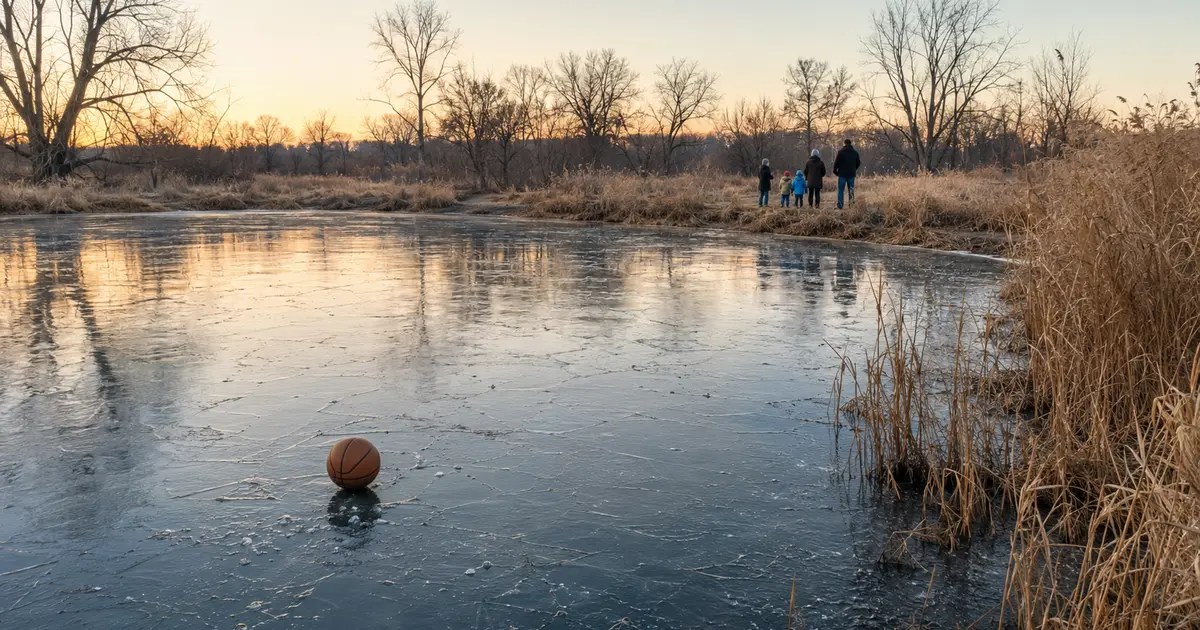
The pond froze early that year. Not all at once and not with permission. A skin of ice appeared along the cattails on Tuesday, reached the dock by Thursday, and covered the dark center before anyone had moved the last lawn chair into the shed. By Saturday morning, winter had placed a clean white question across the water.
People came to look. Children arrived first because ice is an invitation written in a language they understand immediately. Parents followed because ice is also a warning. Fishermen stood near the bank and discussed thickness. Older men who had skated there as boys studied the surface with the confidence of experience and the caution experience is supposed to produce.
The pond becomes a town meeting
No sign had been posted. That made everyone responsible for creating a rule. Four inches, someone said. Five if the water moves. More near the reeds. Less where snow insulates the surface. Every person agreed that safety mattered. No two people agreed on what safety required before lunch.
A father tossed a stone. It struck the ice with a sharp knock and skittered toward the middle. The sound traveled farther than the stone. Children cheered. Adults did not. A dog stepped onto the edge, turned in a circle, and returned to land, having completed the most decisive test of the morning.
The pond had changed overnight, but the people around it brought every winter they remembered. One woman recalled the year the ice stayed strong through February. A man described falling through near the dock when he was twelve, a story he told with enough pleasure to confuse the lesson. Someone mentioned a truck once crossing a lake farther north, which contributed nothing useful but raised the ambition of the conversation.
Waiting is part of the season
In a small town, weather is never only weather. It rearranges time. A frozen pond suggests skates, hockey sticks, sleds, augers, thermoses, and the sudden possibility that an ordinary Saturday might become a day people remember. That possibility creates impatience. The ice looks finished long before it can hold everything imagined on top of it.
The children moved along the bank, testing puddles and breaking thin sheets over mud. Their play stayed close to land, but their eyes kept traveling toward the center. Adults offered instructions from every direction. Stay back. Watch the edge. Do not trust snow-covered ice. Wait another week.
Waiting another week is reasonable advice. It is also nearly impossible advice when a whole pond shines in front of you. The children negotiated inches. They proposed ropes, boards, supervision, and a system in which the smallest child went first because he weighed less. Adults rejected each plan with increasing respect for the creativity involved.
The first safe Saturday
Cold held through the week. Each morning added a little more certainty. The next Saturday, someone drilled near the dock. The measure was taken again farther out. The town did not issue a declaration, but skates appeared. A shovel cleared a rough rectangle. One child stepped onto the surface, then another, and soon the pond carried the scratch and shout of winter.
Nobody skated well at first. Ankles leaned. Sticks missed the puck. A father who had described himself as pretty good moved with both arms extended and fell before reaching the cleared ice. His children helped him up after laughing the correct amount.
The pond did not become safer because everyone wanted it to be. It became safer because the cold kept working while the town waited. That was the bargain. Winter offered something beautiful, but it would not be rushed into carrying people before it was ready.
By afternoon, the bank held boots, cups, gloves, and one folding chair that had finally been taken out of somebody’s yard. The early freeze no longer felt early. It felt like the start of the season. The pond had answered the question in its own time, and the town had arrived when it could finally stand on the answer.