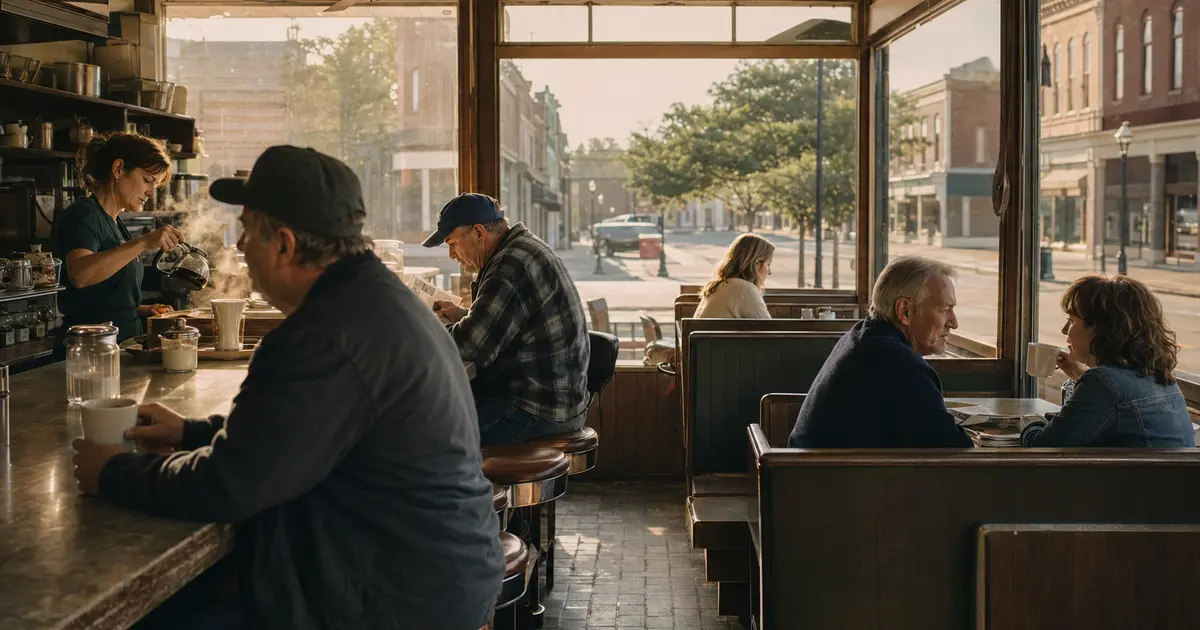
It was not a holiday. There was no parade route, no school calendar telling everyone where to stand, and no big announcement taped to the café door. It was an ordinary Saturday in August, the kind that begins with screen doors opening, mowers starting, and people making quiet lists of what they hope to finish before the heat settles over the fields.
The Johnson place sat a few miles outside town, past the water tower and the last row of houses. A hard wind had come through during the night and lifted part of the machine-shed roof as cleanly as if someone had peeled back the lid of a can. Rain followed. Tools, feed, and two pieces of equipment were sitting under a gray morning sky that looked capable of trying again.
No one had been hurt. That was the first thing people said. The second was that the Johnsons had a mess on their hands. In a larger place, those two facts might have remained information. In Maroa, they became directions.
The road began to fill
The news moved without ever becoming news. Someone mentioned it over coffee. Someone called a brother. A woman leaving the grocery store added three cases of water and twice as many paper plates to a cart that had not contained either one. At the hardware store, a man bought roofing screws, then turned around and bought every remaining box because guessing low seemed irresponsible.
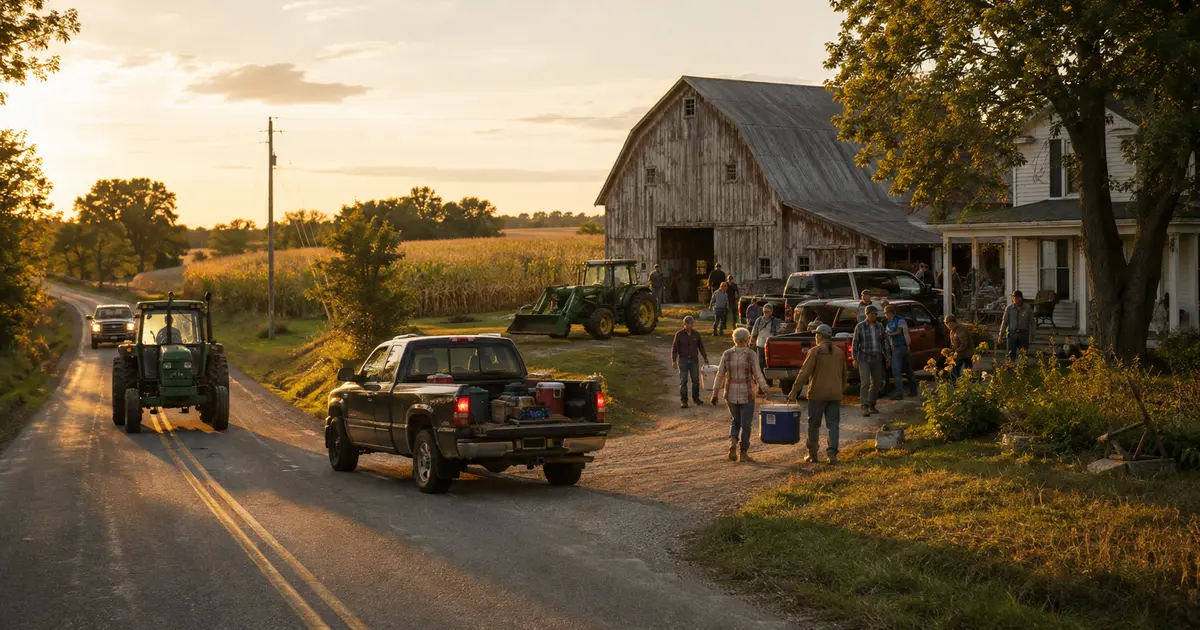
By nine, the first pickup turned onto the Johnsons' gravel lane. It carried two ladders, a generator, and three men who had already discussed the roof from the road. Another truck followed with lumber. Then came a tractor, a utility trailer, a van from the church kitchen, and a teenager whose only visible qualification was that someone had told him to bring work gloves.
Nobody stood at the end of the drive checking names. Nobody asked who had organized the effort because no one had. People simply arrived and looked for the unfinished thing nearest to them. One group cleared wet insulation. Another moved equipment. Two farmers studied the damaged trusses with their hands on their hips, speaking in short sentences that slowly became a plan.
A large problem became a hundred small jobs
That is how a town handles something too heavy for one family. It does not make the problem disappear. It divides it until each piece can be carried. A roof became sheets of metal, rows of screws, measurements, extension cords, water bottles, sandwiches, and somebody remembering to move the nails before a tire found them.
By noon, folding tables stood beneath the shade trees. Food arrived in dishes that did not match and quantities that did not make sense. There were enough cookies for a school concert and enough potato salad for a much larger emergency. People ate in shifts. They talked about crops, ball games, knees, weather, and every subject except the generosity taking place in front of them.
Children carried water. Older men offered advice and, occasionally, a tool. Women moved between the worksite and the tables with the kind of authority that keeps both a project and a community from falling apart. The Johnsons tried several times to thank everyone. Each attempt was interrupted by someone asking where the extra drill bits were or whether the next row of metal looked straight.
No one asked what was in it for them
There was nothing perfect about the day. People disagreed about measurements. A truck blocked the lane and had to be moved twice. Someone brought the wrong size socket and defended it longer than necessary. Heat pressed down on the yard, dust settled on the food table, and the repaired section of roof looked newer than everything around it because, of course, it was.
But by late afternoon, the equipment was dry. The opening was closed. The loose metal had been gathered from the field. The tables were folded, the tools returned to trucks, and the people who had arrived without being invited began leaving without waiting to be praised.
The Johnsons stood near the drive as the last tractor rolled toward town. Behind them, the machine shed was not restored to some untouched version of what it had been the day before. It was simply sound again. Ready for weather. Ready for work. Held up by lumber, screws, and the fingerprints of half the town.
People like to talk about community as if it were a feeling. In Maroa, it was usually more practical than that. It was a truck already pointed in your direction. It was food wrapped in foil. It was a person asking what needed to be done and beginning before the answer was complete.
Nothing about that Saturday made the paper. There was no ceremony when the final ladder came down. By evening, Main Street looked exactly as it had that morning. But the town had reminded itself of something it had always known: when the work is too much for one pair of hands, the answer is not a speech about togetherness. The answer is more hands.