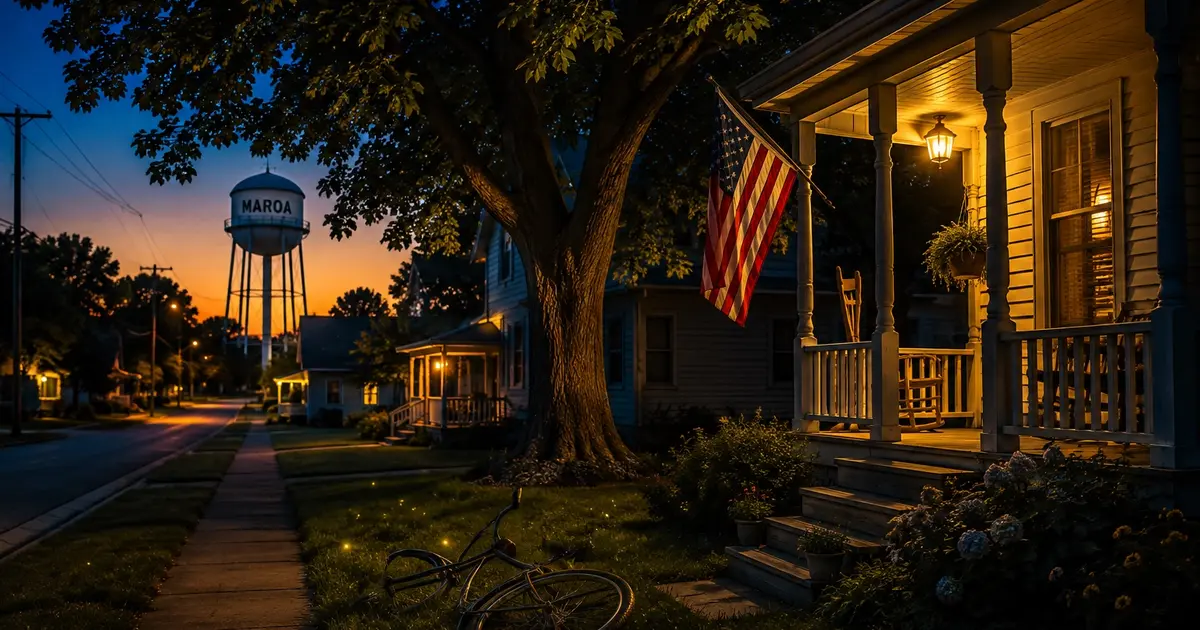
Every small town had at least one porch light that came on for more people than lived in the house.
It glowed before the street was fully dark, usually beside a screen door that had been opened and closed so many times it no longer bothered to meet the frame quietly. Moths gathered around the bulb. A chair sat near the railing. Somewhere inside, a television played louder than necessary and somebody was likely to ask whether you had eaten.
The light was not really there so the family could see its own steps. They knew those steps. They had crossed them carrying groceries, sleeping children, wet umbrellas, school bags, and every other part of an ordinary life. The light was for everyone else. It said someone was home. More than that, it said someone was available.
If your bike chain came off, if rain caught you three blocks from where you were supposed to be, if you scraped a knee, needed a drink, lost track of time, or simply discovered that the ride home had become longer than the ride away, there was a porch where you could stop. You did not need an appointment. You needed only enough sense to walk toward the light.
The light was a kind of address
Children learned those houses the way sailors once learned stars. There was the porch near the school with the metal glider. The white house by the corner with a hose always coiled beside the steps. The place where the garage refrigerator held cans of pop no adult appeared to be counting. Directions did not require street numbers. You went past the porch with the yellow light, turned where the big maple leaned over the road, and if you reached the water tower, you had gone too far.
A porch light could solve several childhood emergencies. The people behind it usually had a telephone, a Band-Aid, a pair of pliers, and a towel that smelled strongly enough of fabric softener to repair a person's entire afternoon. They might not fix the bicycle correctly, but they would turn it upside down in the driveway and work the pedals until the chain stayed where chains were supposed to stay.
They would call your mother after giving you something to drink, which was not the approved order but was the order everyone used. Your mother would say she had been wondering where you were. The person on the porch would say you were fine. Both adults would add a few sentences about weather, family, or supper before remembering that the purpose of the call was your safe return.
Then you would ride home beneath a sky that had grown darker while the adults talked, carrying the useful knowledge that the town contained more than one place where somebody would notice you.
You did not have to explain why you were there
Some people never locked the door. They just left the light on. If you knocked, a voice might yell, “Come in,” before anyone had confirmed who you were. This was a security system based almost entirely on recognizing the rhythm of a person's knock and assuming that anyone dangerous would probably not wipe his feet.
The porch was the space between public and private life. Neighbors could sit without becoming company. Children could arrive without becoming guests. A dog could sleep beneath the steps and belong to three families before supper. People traded tomatoes, tools, rumors, and the last ten minutes of a ball game without crossing fully into anybody's house.
On summer evenings, the light stayed on while adults talked from chairs and children moved in and out of the yard. Nobody announced that the porch was a safe place. Nobody printed rules for it. The promise became clear because the people who lived there kept it, night after night. A glass of water appeared. A cut was cleaned. A parent was called. A kid was sent home before worry turned into anger.
It was not that every door stood open every hour. Families slept, argued, traveled, and sometimes turned every light off because they did not feel like seeing another human being. The signal mattered precisely because people understood it. A dark porch meant keep moving. A lighted one meant you could stop.
The town kept track without tracking you
Parents did not always know a child's exact location. They knew the route. They knew the houses along it. They knew which porch would catch him if the sky opened or a tire went flat. Responsibility overlapped from one yard to the next, not through a formal agreement but through the shared understanding that a child temporarily in front of your house had become, in some small way, your concern.
That world was not as perfect as memory sometimes edits it. Children still got hurt. Adults still worried. Doors should sometimes have been locked when they were not. A porch light could not prevent every danger, and small towns had no special protection from the troubles carried by people.
But the light represented something useful that safety alone cannot provide: belonging spread across more than one address. Home was where your family lived. The porch light was proof that home had outposts.
A child on a bicycle might be thirsty, embarrassed, soaked, or afraid of being late. He was not stranded. Somewhere between where he was and where he belonged, a yellow bulb was already burning for him.
The bulbs got brighter
Homes have brighter lights now. LED fixtures can illuminate an entire driveway while using less electricity than the old bulb used to warm one moth. Motion sensors catch every passing cat. Cameras send a notification before a visitor reaches the steps. A modern floodlight can greet a delivery driver with the intensity of a prison escape.
Those things are useful. Doors are locked for good reasons. Families are busy. Children carry phones, and help can be summoned from almost anywhere. No sensible person needs to pretend every part of the old arrangement was safer simply because it happened a long time ago.
Still, a light that turns on because it detected a body is not quite the same as a light someone left on for a person.
The old porch light did not ask for a password. It did not begin recording. It did not wait to learn whether you belonged to that house. Its meaning came from the people inside and the promise they had made through a thousand ordinary evenings: if you need something, start here.
Maybe that promise has not disappeared completely. Maybe it only needs to be switched on again—one house, one porch, one family deciding that the light can shine a little farther than its own front steps.
We have brighter homes now. We can turn their lights on from anywhere in the world. But there are fewer porch lights that tell a child in the dark the one thing the old ones said without a word: you are not too far from home. Come on in.