There were eleven keys in the tin under the hardware-store counter. Ed would have said ten. One had been there so long that he no longer counted it.
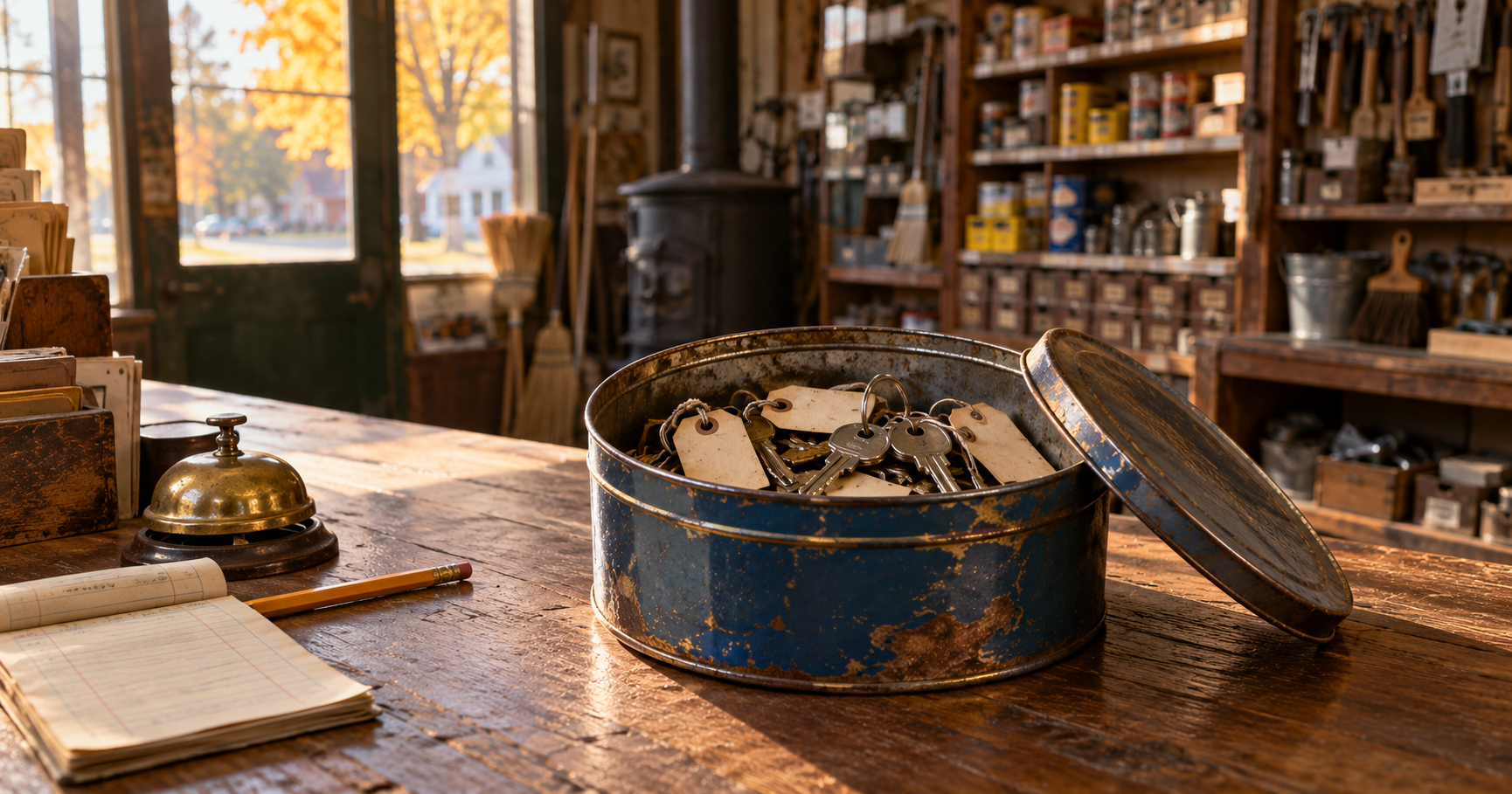
The tin had once held coffee. Its blue paint was scratched around the rim, and the lid made a short metallic complaint whenever Ed lifted it. Nothing on the outside said what was inside. That was the point.
People came to his store for screws sold one at a time, a length of chain cut to fit, or a bolt that looked almost right until Ed held it beside the broken one. They did not come because he had spare keys. The people who had left a key knew he had it, and Ed knew whom to call before he gave one back.
A church-hall key was tied with red yarn. A back-door key had a square paper tag. Another carried a phone number written so lightly that Ed had to tilt it toward the window to read it. None had a street address.
On the first wet Saturday of October, Ed was counting the register when the bell over the door rang. A woman came in with a girl whose soccer socks were dark with rain. The girl held a paper bag against her chest. Inside it was a loaf of bread, beginning to soften at the corners.
The woman asked whether Ed still had her mother's spare key.
He looked at her a moment. 'I think so,' he said. 'Is she expecting you?'
'She asked us to bring supper. She's at the clinic with my brother. I left my own key on the kitchen table.'
Ed reached for the phone before he reached for the tin. The girl's grandmother answered on the fourth ring, recognized her daughter's voice, and told Ed where she had left the porch light switch. Only then did he lift the lid.
The woman had not thought of the tin in years. Her mother had left that key when the girl was a baby, back when Ed sometimes opened the shop early so she could buy a furnace filter on her way to work. The girl's mother remembered carrying her in one arm while searching her coat pocket for change with the other.
Ed found the key with the faint phone number. He held it up. 'This one used to have yellow string.'
'It did,' the woman said. 'She used the string for Christmas packages.'
Ed put the key on the counter. The girl looked from the key to the tin. 'Do you have everyone's house in there?' she asked.
'No,' Ed said. 'Just a few people who asked.'
Outside, rain moved across Main Street in the flat, determined way it does when no one has brought a proper coat. Ed found a dry paper sack for the bread and waited while the woman tucked the key into the zipped pocket of her jacket. He did not ask her to sign anything. He had already made the call that mattered.
The woman returned Monday with the key. The grandmother was home. The bread had survived. She brought Ed a slice of the apple cake they had eaten after supper, wrapped on a plate with the kind of plastic wrap that never quite stays flat.
Ed set the plate beside the register and put the key back in the tin. He wrote the grandmother's current number on a new tag, then stopped before adding her address. He already knew where she lived. Anybody else who found the tin did not need to.
By noon the cake was gone. A customer came in for a hinge. Another needed four screws and bought six because Ed said two would end up on the floor. The bell rang, the register opened, and the tin stayed beneath the counter.
It was not a town-wide system. It could not have been copied into a larger shop with a printed sign and a line of people waiting. It worked because each key came with a person Ed knew, a person he could reach, and a reason to ask before opening anything.
That Saturday, the girl learned only that her grandmother's supper could get inside before it went cold. Ed put the lid back on the tin. The sound was small enough to disappear under the bell when the next customer came through the door.