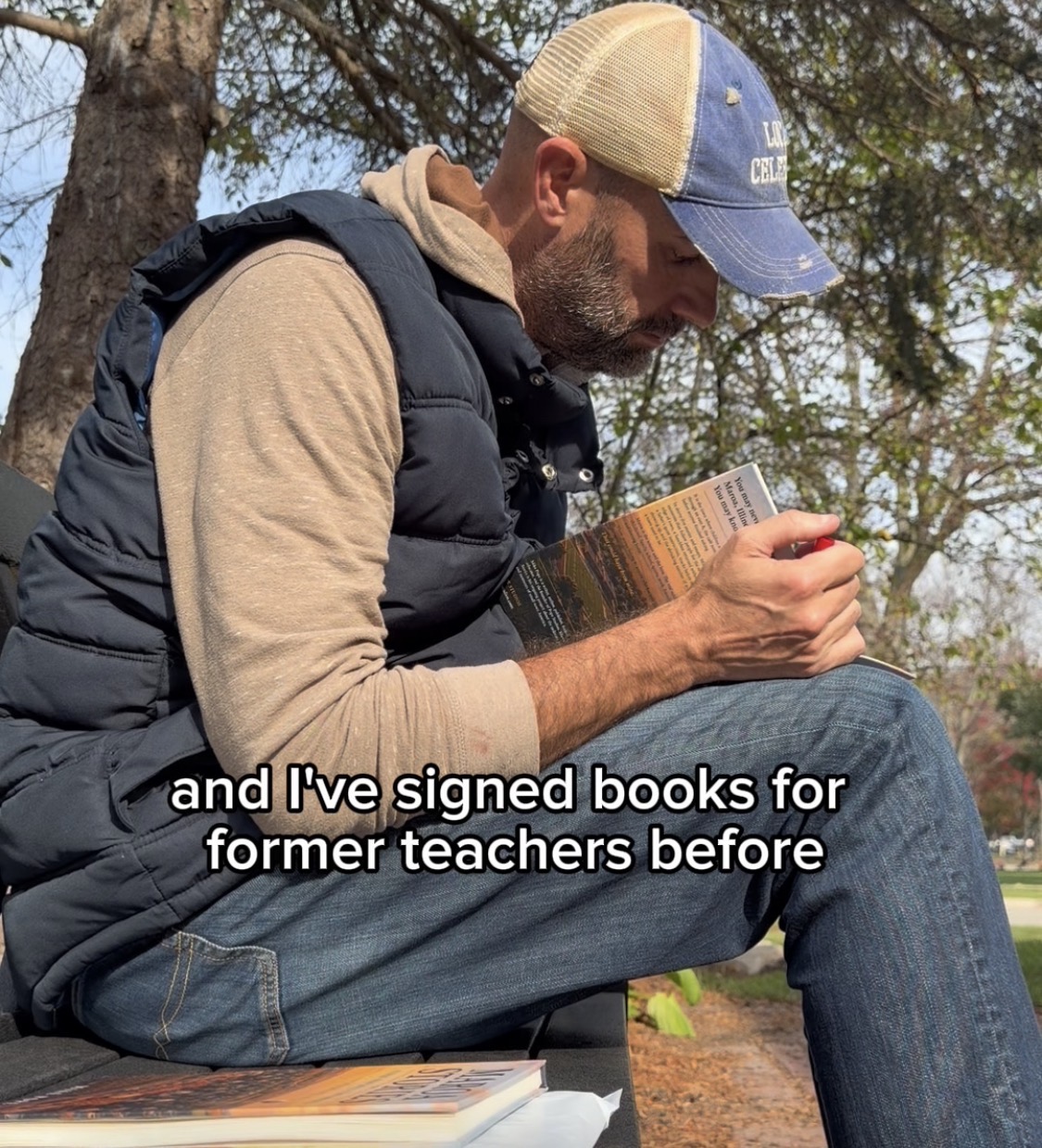
I was signing Maroa Stories books when I got to a copy for Mrs. Gilman, one of my elementary-school teachers from Maroa.
I’ve signed books for other former teachers. But this one made me stop and think about the distance between the child a teacher knows and the adult that child may become.
The kid in the classroom had grown up to write a book about the town where that classroom stood.
I don’t know what Mrs. Gilman imagined for my future. I wouldn’t pretend to know.
But I started thinking about how much of a person is still invisible when we meet them as a child.
There is something about my own writing that helps explain why.
I have always loved telling stories. I did not love the physical work of writing them down or typing them out. Today, being able to speak my thoughts gives me another way to get those stories onto a page.
The telling and the recording were different parts of the work.
That distinction matters. A person watching a child struggle with one part of an assignment may not yet know what is happening with the other parts.
A page can tell us something important about a student’s writing. It cannot, by itself, tell us everything that student has to say.
And yet schools have to make judgments from what they can see.
Teachers need to know whether children can read the words, understand the passage, explain the idea or work through the problem. Parents need honest information. A child who needs help should receive it.
Useful evaluation gives us a place to begin.
My concern is what happens when that beginning becomes the description we carry forward.
The struggling reader. The quiet kid. The kid who won’t do the work. The one who has so much potential but never seems to use it.
Some descriptions may begin with a real observation. The child may genuinely be struggling. Work may genuinely be missing.
But an observation and an explanation are different things.
A missing assignment tells us the assignment is missing. Understanding why it is missing requires more information.
That matters because our explanation helps determine what we do next.
If we assume the child does not care, we may concentrate on consequences. If we discover that the child cannot get started, cannot follow the directions or does not know how to show what they understand, we have a different problem to solve.
Those possibilities are questions to investigate. They are not diagnoses we can make from an empty page.
I want us to be more careful about the moment when we stop asking.
We can describe what a child is doing right now and still leave room for a better understanding of that child.
We can say an expectation has not been met without deciding that the student is the kind of person who will never meet it.
That takes more than adding the word “yet” to a sentence.
It takes giving the child another opportunity, examining what made the task difficult and being willing to revise our explanation when new information appears.
Consider a hypothetical student who tells a thoughtful story aloud but produces very little when asked to write it.
The difference deserves attention.
The teacher still needs to teach writing. The child still needs practice putting ideas into written form. Hearing the story aloud also gives the teacher information about ideas, language and understanding that the unfinished written page may not reveal.
Both pieces of information can matter.
A different way to respond should help us understand the learner more accurately. It should not become an excuse to ignore a skill the learner needs.
The goal is to find a way into the work.
I think about this as a former educator. I think about it as a father. And I think about it as somebody who now makes things in ways the younger version of himself might not have imagined.
My experience does not tell me what every child needs. It reminds me to be cautious about how much I think I know.
The adult who writes the book is not fully visible in the child sitting at the desk.
Neither is the adult who will build something, care for somebody, solve a problem, raise a family or become the person other people rely on.
A school cannot see all of that in advance. It can make room for more of it to emerge.
That is one reason I want schools to examine the opportunities attached to their judgments.
When a child struggles, does the next decision create a better chance to learn? Does it provide support, useful feedback and another attempt? Or does the description follow the child into the next room while the adults become less curious about who is arriving?
I would want a teacher receiving information about my child to know about a real difficulty.
I would also want that teacher to meet my child.
The record should help the conversation. It should leave room for the child to surprise the people reading it.
Parents have a responsibility here, too.
We can become attached to the story we tell about our own children. We may call one the academic kid and another the athletic kid. We may explain a struggle so confidently that we overlook evidence that our explanation needs to change.
The good labels deserve examination alongside the difficult ones.
A child described as naturally successful still deserves help when something becomes hard. A child known for one strength deserves opportunities to discover another.
Leaving room for growth also means taking the present seriously.
If a child needs help today, an optimistic story about their future is not enough. We need to respond to the difficulty in front of us while remembering that it is only part of the person in front of us.
That is the kind of accountability I want: honest about what is happening, specific about what adults will do and willing to look again.
Signing a book for a former teacher brought that larger question into a very ordinary moment.
I was thinking about the boy she knew and the man signing his name.
There was a great deal of living between them.
For the children in our classrooms now, that living is still ahead.
We should help them with what they need today. We should also be careful about the limits we place around a future we have not seen.
What might the child in front of us be able to do that we haven’t given them a way to show us yet?
— Mike Pope The Sunday Disagreement | Pope Studios