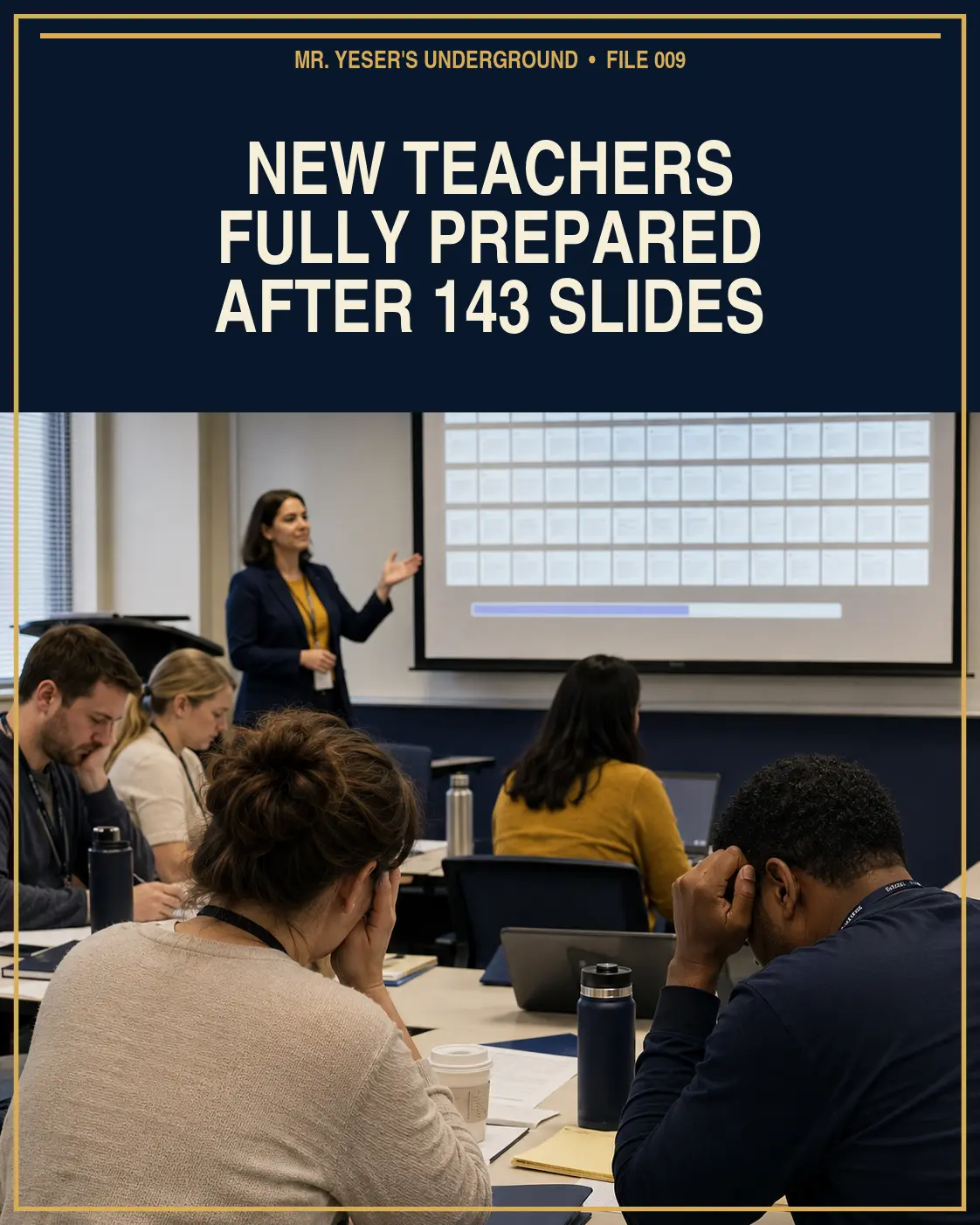
The Office of Professional Readiness announced Thursday that 26 first-year teachers are fully prepared for the school year after completing a three-hour orientation covering every situation they will encounter.
The New Educator Readiness Experience began at 8:00 a.m. and concluded at 11:07, seven minutes behind schedule because the presentation on instructional flexibility could not be shortened.
District leaders said the program gives new teachers everything they need to manage classrooms, answer parents, recognize legal concerns, protect student safety, implement six instructional platforms, supervise hallways, cover vacant classes, and remain personally well.
“No one should enter a classroom feeling unprepared,” Assistant Superintendent for Human Capacity Lauren Mercer said. “That is why we addressed the entire profession in one continuous slide deck before they received their keys.”
Readiness was delivered before lunch
The first 38 slides reviewed the district mission, portrait of a graduate, strategic commitments, visual identity, email signature format, and the approved order in which employees should list the strategic commitments when asked.
Teachers then completed an interactive classroom-management segment. Participants viewed a photograph of a student with his hood up and selected the response most aligned with the district’s relationship-centered expectations. The correct answer was “build rapport,” although the program did not specify what to do during the remaining 179 days after rapport had been selected.
A seven-minute lesson on parent communication prepared teachers for every possible family interaction. They were told to respond promptly, avoid responding while angry, document everything, assume positive intent, maintain boundaries, be available, and never allow availability to interfere with boundaries.
Mercer said the balanced guidance was intentionally realistic. “Teaching requires judgment,” she explained. “We have included that judgment on Slide 84.”
Every emergency now has a bullet point
The orientation devoted nine slides to student safety, mandated reporting, medical emergencies, threats, bullying, online conduct, confidentiality, and the location of the employee handbook section containing the complete procedures.
New teachers were advised to stay calm, act immediately, avoid conducting their own investigation, notify the correct person, preserve exact language, follow state law, follow district policy, and ask their principal if they remain unsure. Principals were attending a separate orientation and could not be reached.
During a scenario exercise, a fictional student disclosed a serious concern two minutes before the bell while another student threw a pencil and the classroom phone rang. Participants had 45 seconds to identify the correct response before the presentation advanced automatically.
All 26 teachers passed after the facilitator reminded them that the exercise was not intended to create stress.
Support remains fully available
Each new teacher has been assigned a mentor. The district’s four mentors will support the 26 new hires while teaching full schedules, leading committees, and completing monthly mentor-contact verification forms.
Teachers may request help through the Educator Support Portal. Requests are sorted into Instruction, Behavior, Technology, Family Communication, Compliance, or Other. Selecting Other opens a message explaining that unclassified concerns should be discussed with the building administrator.
The district also introduced a wellness resource reminding employees to sleep, drink water, set limits, avoid taking work home, answer family messages within 24 hours, attend evening events, prepare thoroughly, arrive early, and use Sundays to create a sustainable plan for Monday.
Officials emphasized that self-care is a shared responsibility, which is why individual teachers will be responsible for completing it.
Experience has been converted into a checklist
Several veteran teachers volunteered to speak with the new group about the first year. Their session was removed when earlier presentations ran long, but organizers preserved the space by adding a slide containing the sentence “Give yourself grace.”
Participants received a 96-page readiness handbook, a district lanyard, a map, three login sheets, and a checklist confirming that they understand where to locate materials they have not yet had time to read.
One teacher asked whether the district expected new hires to feel confident after orientation. Mercer clarified that confidence is not required until the first staff photograph. Competence will be evaluated during the first formal observation.
“They will learn more once students arrive,” she said. “Orientation is how we certify that the learning has already occurred.”
Mr. Yeser praised the district’s complete preparation model. “Absolutely,” he said. “The first year contains situations no presentation can reproduce, so the responsible approach is to put all of them in a presentation. Once the slides have been viewed, experience becomes an implementation detail.”
The new teachers reported to their classrooms at noon. Their keys opened the building but not their classroom doors. A support ticket has been submitted.